About
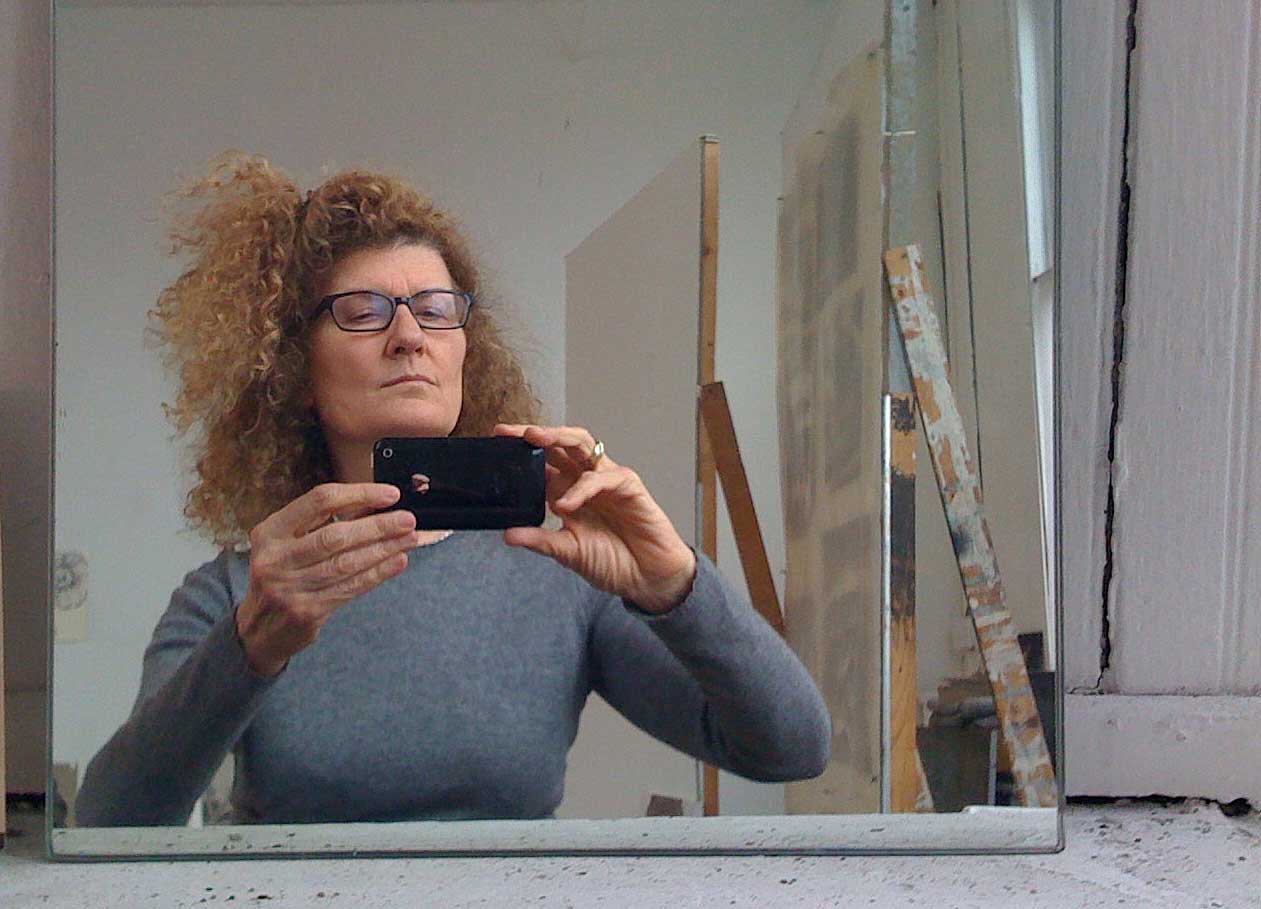
Gail Marks lives and works in New York. She studied English and art history at Smith, and painting at Columbia and the Art Students' League. A scholarship to the Provincetown Art Workshop brought her to Cape Cod, where she has become a part-time resident, and where her practice transformed from abstract-expressionist studio painting into work that has a deep connection with nature.
"I connect with my subjects in a physical way. I seek freedom of gesture. I want to reveal transformations of color and light as I experience them.
She has shown her work widely, most recently in a solo exhibition, Poppies Sky Water (2016), at Gaa-Gallery in Wellfleet, MA, and in 2014 in Italy at Il Biennale d'arte Contemporanea di Oggiogno-Lago Maggiore, where she had an installation of large ink self-portraits. Her work is in numerous private collections.
an interview by Kirsten Anderson from the catalog essay
Gail Marks’s Long Island City studio is an oasis of color-based inspection. Along the walls are gestural seascapes, still lifes of flowers and succulents, large scale portraits, sky and cloud paintings, and simple, evocative color studies. For decades Gail has worked in both her New York studio and outdoors on Cape Cod, cultivating a sophisticated command of line, color, and space through a variety of processes and considerations. She is an abstract painter, a landscape artist, an expert draftsman and an astonishing practi-tioner of fluidity. Gail Marks is a seeing artist, a painter who seeks to capture “the whole expanse of sky.”
Can you discuss your early process of night drawing on Corn Hill in Truro, Massachu-setts? So many landscape painters rely on light as a primary source of information when working en plein air, but you seem to have inverted this concern when working at night.
It was the early 80s, and I was stuck: an urban painter in the middle of nature. I thought, Maybe I’ll try what’s most beautiful to me— the sunset. I was renting a house near Corn Hill, and from there I went to the sea. I went out to try nature, and I stayed. It became incredibly exciting, after sundown, to see the theatrics the sky played. I lost myself completely, trying to catch it all.
Forms become enormous as the sky darkens. Clouds clear. There is always some light. I would set up at the top of one particular dune, lean my board against the same clump of grass, and go to it. I tried to encompass the entire vault of sky. It was very exciting, keeping up with the changes out there.
The whole process has always been about light: after sunset, the show is just starting. Until I began working outdoors, I was primarily an abstract painter. My pictures had a structure that I thought was invented, but looking at them now, they remind me of trees.
In your collection of small gestural seascapes, there is a deep, sensorial quality of color, as well as a looseness in terms of application and shape. I wonder if you’re able to artic-ulate how you achieve both elements in a such a small physical space.
I did night skies in charcoal from 1980 until around 1990. Nighttime was my time, but one finally gets tired of the same process. I wanted color, and I wanted a daytime project. I went out with watercolors, which I had not used before, and began to really learn color and space.
From my earliest times as an artist, I’ve tried to portray space and have strived for a free brush. A free brush is what happens when one is absorbed. I worked on these small scale pictures be-cause I was carrying a physically heavy load out on the beach. The project was initially borne of necessity— I was hiking pretty far out.
One's imagination can make a very small page feel like it contains the whole vista. When I work small, I feel like I can capture the whole space I'm in.
You’ve spent most of your life as a city dweller in Manhattan. And yet, your work draws largely on nature: seascapes, florals, a series of blue skies. Can you talk a bit about your instincts to engage with the natural world in your work, versus working with the physical elements of urban life?
I’ve never wanted to work with what I look at in the city. When I’m there I engage with other art. I’m always in museums and galleries. My studio life is not a reflection of what’s found in the city. Rather, I paint the sky. I work in still life. I explore.
For awhile I was intimidated by nature. My first experience working in nature was inspired by a trip to the bayou in Louisiana. I made a lot of photographs that resembled my abstract studio paintings, so I had a link. I painted trees and water, hunks of marshland, all in oil on small wood panels. This was my entry into the natural world, my assurance that I could “do nature.”
I’ve always been a draftsman, and with my seascapes I’ve tried to escape that by freeing up the brush. One learns to look, as an artist. And when I began to really look, and see, and explore the unknown, it was in the natural world.
In the early 90’s you completed a series of Cosmos pieces, several of which are included in your current show. These paintings rely on a physical sense of texture, as well as muted color. And yet, they appear quite aligned with your continuous gaze toward the natural world. You’ve also referred to these pieces as “closing in on an inch of a Pol-lock.” Can you speak a bit about that sort of visual comprehension, about the aesthetic and conceptual values of close consideration?
I think of the Cosmos pieces as abstractions. There are no intentional arrangements in this se-ries: the process is very wet, and I liked that way of working. There was very little control. Before the Cosmos series I was making very large oil paintings in my studio, using earth colors because they were less expensive and I was covering a lot of canvas. I really knew these colors—I don’t think of them as muted. I wanted to learn how to create the rich darks and and emerging light I was getting in the charcoal night skies. I also wanted to attempt the range of light found in a Rembrandt. The focus that required—those layers of wet on wet— honed in on the threads of the canvas, as well as surrounding emptiness.
When I say “inch of a Pollock,” I’m referring to the way that a single splash can be a window into the universe. I do love Pollock’s great drip paintings, but I wasn’t doing those. It’s hard not to think of Pollock whenever one sees a drip. Any random splat can become a good composition if you work at it. I think abstraction is a way of coming closer and closer into something.
You also work quite a bit with still lifes, and your drawings of poppies in particular are electric. Their furry stems are almost menacing, and the flowers themselves carry various emotional states. Do you aim to communicate a particular set of emotions with the-se drawings at the outset, or does the emotional state of each drawing reveal itself over time?
The emotions definitely reveal themselves later. Poppies are incredible. The flowers are silk, and the colors flamboyant. But poppies are also hairy and animal-like. They draw me in with their gorgeousness and with their ugliness, the twisty way they open up and move. They seem to sense each other’s presence. I was attracted to all of this, so I drew, and drew some more, fascinated by the results.
At the city flower market, poppies are sold in bunches of 50, and for just three or four months each year. Having such a wealth of flowers was like having buckets of paint— a great gift. I really wasn’t interested in painting their color. I loved the creaturely quality, and the space they created. It became such an assignment, a challenge. I think I always want to get things right.
As I draw a particular group, the poppies are undergoing change, which I try to include and adapt into the drawing. This is similar to changes in the night sky. Both create their own com-positions; both are about growth and expansion.
There is a masterly fluidity to your seascapes, and you’ve mentioned a desire to move toward looseness. Can you describe what looseness means to you as an artist?
Looseness means losing oneself, being free and precise at the same time. It’s like Chinese calligraphy. The whole enterprise is rooted in trying to be able to paint what I see.
When this is working the way I want it to, my process feels like a merge. I am merged with my subject; hand and eye are one. There is a loss of self and a discovery of vision. There is precision of color and precision of line. There’s zero self-consciousness, only freedom.
You’ve been a working artist for over 35 years. As you move from still life to seascape and from large scale paintings to smaller scale work, you describe your driving aesthetic as a desire to “see more and more.” This is a beautiful and elegant phrase: can you speak more to this concept, and how it informs your studio life?
When I drew poppies for the first time, the picture was very strong, simple, and a little rough. The next time, I saw more detail and felt the need to include it. So I literally saw more and more as I went on. When I make watercolors, often I will paint what I see carefully, learn it, and then I am free to improvise.
Sometimes I make sketches to get away from the constraint of having to “get it all in.” Or I may switch mediums. I want my sketches to play and to be observant. I want to have a deeper un-derstanding of the natural world. I can never stop looking. This is art to me. Spending a life studying what you’re curious about.
— from a catalog essay for the show Poppies, Sky, Water at the GAA Gallery, Wellfleetm MA, August 2016
Contact:
917-376 6461
gailmarks@me.com